CLICK! CLICK! CLICK!
Entry forms can be downloaded now on the photo competition page.
See the flyer below for all the key dates, categories and prizes!
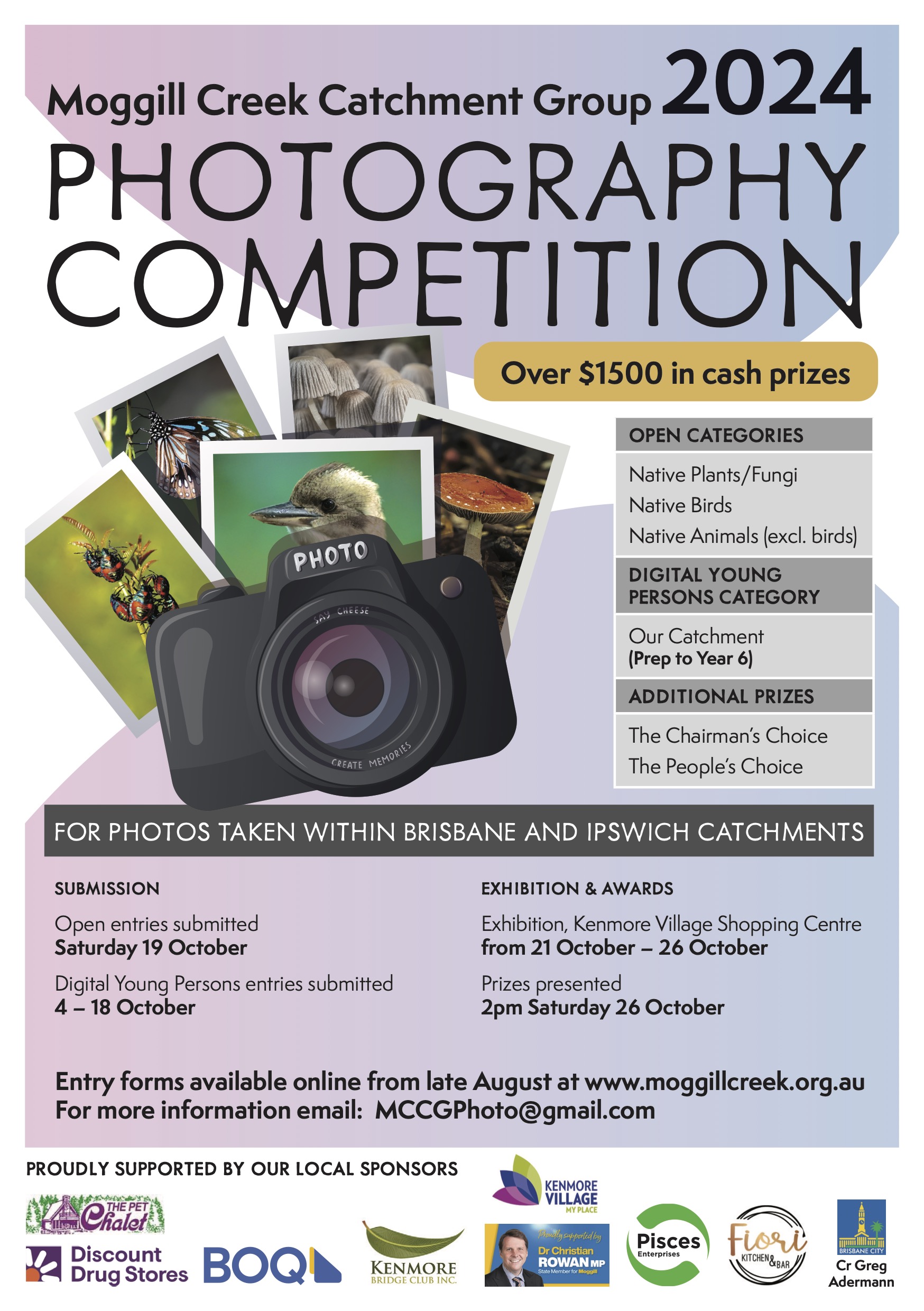
CLICK! CLICK! CLICK!
Entry forms can be downloaded now on the photo competition page.
See the flyer below for all the key dates, categories and prizes!
Wildlife Matters is published in: 
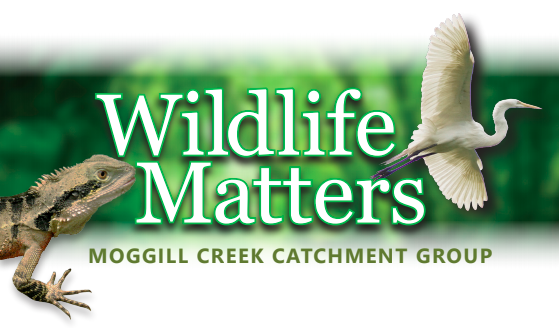
The Masked Owl – an enigmatic and mysterious nocturnal bird
The photos below of a Masked Owl taken by Moggill Creek Catchment Group (MCCG) committee member Chris Bruton on his property near Gap Creek. The Masked Owl (Tyto novaehollandieae), is distinguished from its relative, the Barn Owl, by its dark-ringed facial disc markings, white spots on checkerboard-dark wings, dark spots on a pale chest, and very large, apparently oversized talons. This was a very exciting observation, as these birds are not often seen, and very seldom as clearly and distinctively as this. Quite by chance, another acquaintance showed me a picture of another individual of this species beside a bikeway near Jindalee Bridge a few days later. This bird had all the same features, but with somewhat darker plumage.
The general impression of a Masked Owl is of a large dark owl with a knowing and somewhat unnerving gaze, often flying off silently and unexpectedly. One comes away with a notion of a formidable, shadowy, and silent bird of prey. In fact, Masked Owls are our second-largest nocturnal bird (the largest being the Powerful Owl). They have several plumage forms, some of which are dark rufous below, with other forms being much lighter-coloured (which Chris’s bird appeared to be).
Masked Owls have a distinctive call, rather like a set of rasping, far-carrying (and even more unnerving) screams, and often are quick to fly on disturbance, usually after being seen from a distance in a spotlight beam. Sometimes the call alerts one to their presence, but mostly they appear to be difficult to find. Like most other owls, they have a very bright greenish eye-shine, demonstrating their powerful ability to find prey in poor light. Their large rounded to heart-shaped facial disc acts as a “radar-dish” to concentrate sound that these animals also use to hunt by.
Their very large talons point to their primary food source: rats and other small mammals, usually taken on the ground. In southern Australia, rabbits are often caught. For this reason, Masked Owl habitat often seems to be a combination of both well wooded open forests with tall trees, and open grassy unwooded areas of either cleared land or heath. It is along these boundaries that these owls wait for prey, with the excellent view of the ground that is afforded in such locations. The related and relatively abundant Barn Owl tends to be found in more open habitats, often grassy areas within farmland and croplands.
Atlas of Living Australia records suggest that this species is more often observed between September and January, and very seldom recorded in other parts of the year. However, even in known locations, they are only irregularly observed.
An interesting and engaging account of Masked Owls in Australia can be found in “Birds of the Night: Owls, Frogmouth and Nightjars of Australia” by Dr David Hollands, published by Reed Books in 1991. I was lucky enough to meet David, an engaging ornithologist and country doctor, who just happened to live in the same town in Victorias’ East Gippsland where I was working at the time.
Sandy Pollock
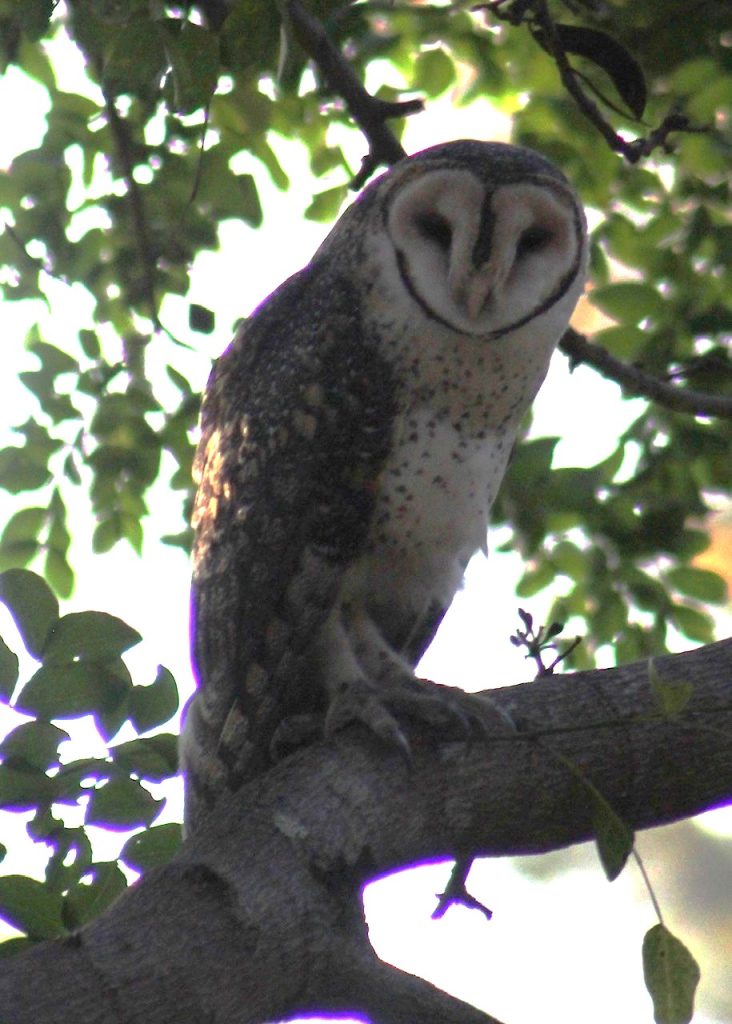
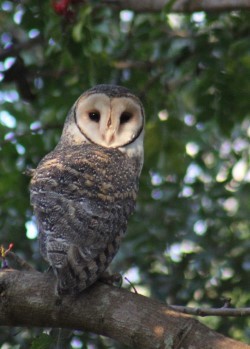
Masked Owl Photos: Chris Bruton
Wildlife Matters is published in:
Another fantastic newsletter is out now. What can you expect in the Winter Newsletter?
There are awards, echidnas, gliders, koalas, weeds and orchids and much, much more. Meet our new secretary and find out all you need to know about the MCCG photo competition.
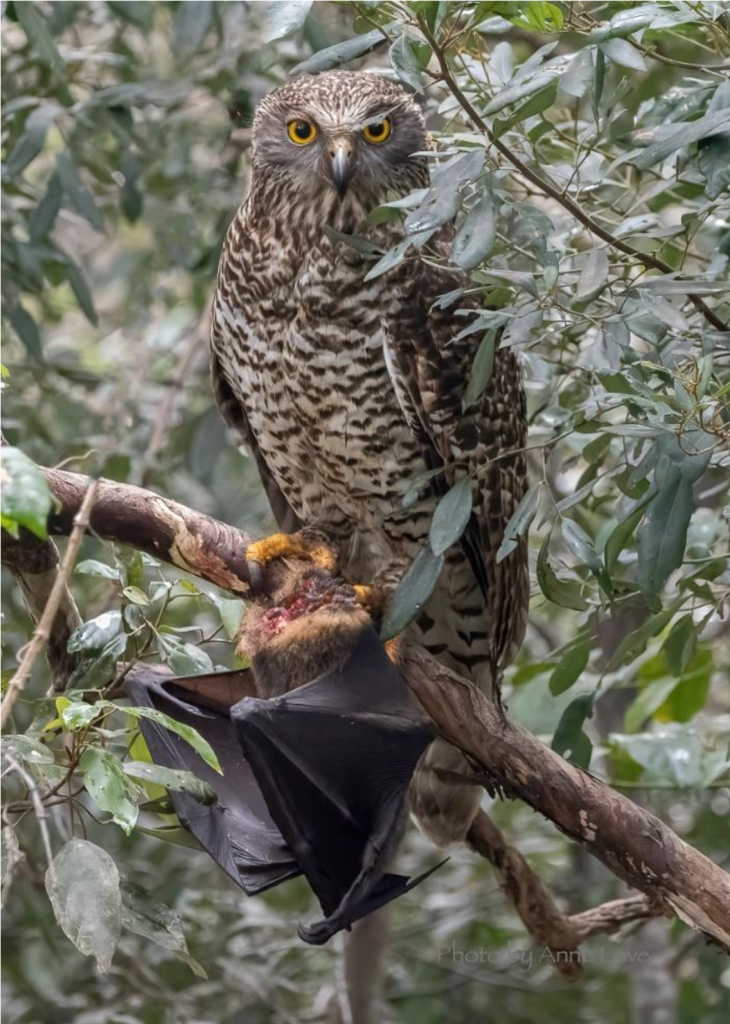
Powerful Owl
Photo: Anne Love 2023 winner photo composition
Please join us for the next MCCG public talk:
Come and hear Dr Vanessa Gorecki, QUT zoologist, discuss the findings of her detailed studies into the fascinating ecology and population dynamics of this river-foraging microbat. Dr Gorecki is a highly-respected zoologist, ecologist and consultant, who as a former Brookfield resident, has closely studied one of our most interesting local mammals.

This much loved Moggill Creek Catchment Group event is just around the corner.
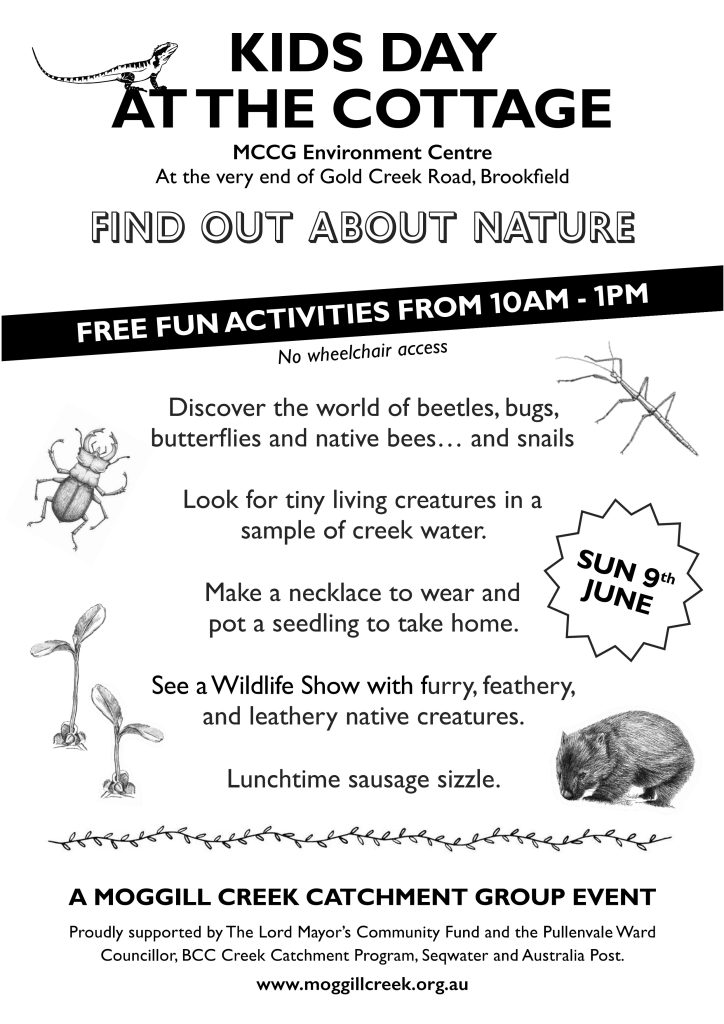
10am-1pm on Sunday 9th June.
Looking for tiny creatures in water from the creek is just one of the activities at the free annual KIDS DAY AT THE COTTAGE.
Kids can see, make, and do, while they find out more about nature, beetles, bugs, butterflies, native bees, and snails. They can meet furry, feathery, or leathery, native animals in one of the two Geckoes Wildlife Shows.
It is on the grounds of the Cottage on Gold Creek Dam Reserve, a bush setting with no refinements (and unfortunately no wheelchair access). It features outdoor marquees and display areas with expert presenters and plenty for kids to see and do.
There’s a lunchtime sausage sizzle and fresh town water to refill your water bottle.
Bring your youngsters to Kids Day at the Cottage 10am-1pm Sunday 9th June.
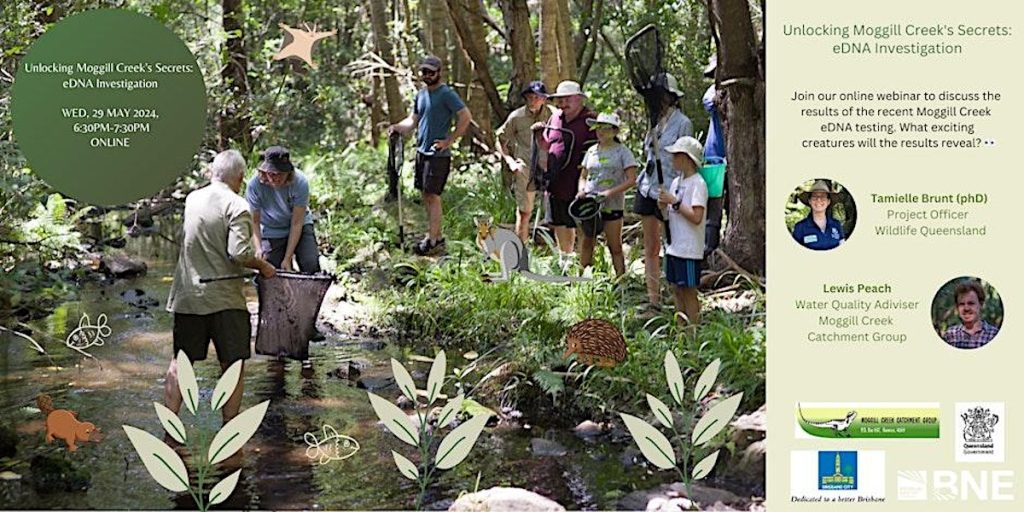
Join us for a online webinar featuring ecologist Tamielle Brunt from Wildlife Queensland, and Lewis Peach, Water Quality Advisor for the Moggill Creek Catchment Group, as they unveil the intriguing findings from the recent Moggill Creek eDNA Investigations. This initiative marks the first application of this type of analysis within the Moggill Creek Catchment, and potentially the Greater Brisbane area. This session will spotlight the array of animals detected in Moggill Creek through advanced eDNA analysis. Discover which unexpected wildlife species are present in this catchment. Don’t miss this chance to dive deep into the hidden biodiversity of Moggill Creek, and discuss the implications for conservation, and research.
During the recent event in the Moggill Creek Catchment, volunteers gathered to collect eDNA samples across 6 sites, a pioneering effort aimed at uncovering the hidden biodiversity within the creek.
For any inquiries or further information leading up to the event, please feel free to reach out to us at [email protected]
This event is made possible with the support of the Queensland Government – Queensland Citizen Science Grants, Brisbane Airport Corporation, and Brisbane City Council.
On the morning of Sunday 21st of April a group of 16 intrepid Queenslanders gathered in the parklands behind Brompton Place, Brookfield for a native tree planting, as part of Queensland Conservation Council’s Protect Beautiful Queensland week of action. The event was organised by the Huntington/Tuckett Bushcare Group, in association with Brisbane City Council (Habitat Brisbane). The site had been prepared in advance by contractors for Habitat Brisbane, who had removed several large Chinese elm (Celtis sinensis) weed trees and chipped them. After herbicide spraying to suppress growth of Chinese elm seedlings, the resulting wood chips were spread to provide a deep layer of mulch for the plantings.
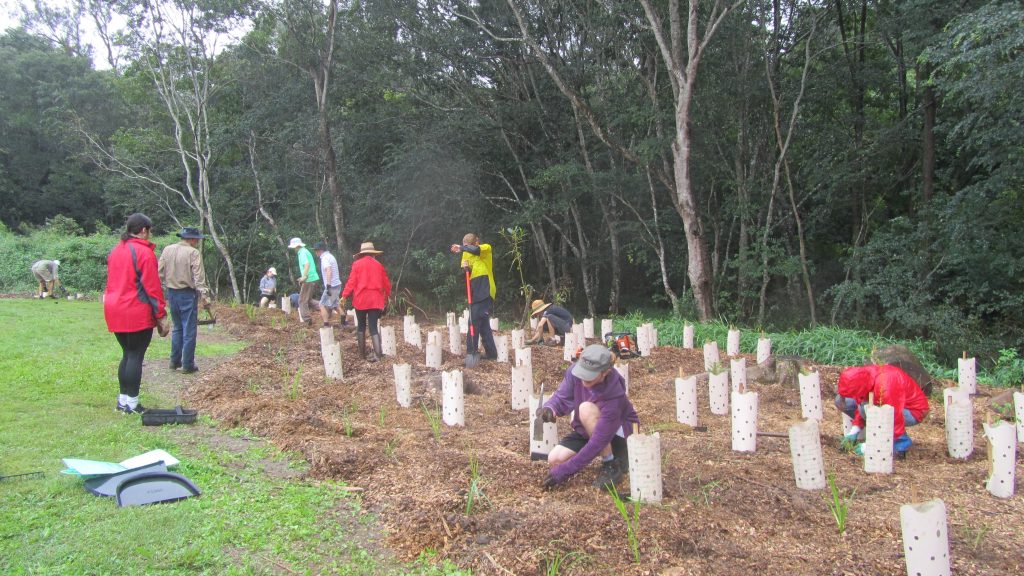 This section of the riparian zone of Moggill Creek, between the Branton St. footbridge and Tuckett St. park is dominated by Chinese elms. Unfortunately, these exotic trees tend to take over the native vegetation, casting a deep shade in the summer months, which supresses the growth of native ground cover and mid-storey. Over the last few years, the Huntington/Tuckett Bushcare Group has been gradually removing these weed trees a few at a time and replacing them with native trees and shrubs local to the area. The aim is to increase biodiversity and render the site more conducive to native wildlife.
The weather over the days leading up to the working bee had been very wet, but fortunately on the morning of the event the rain eased to a light drizzle and so we were able to go ahead and plant around 360 native trees, shrubs and ground cover. As is usual with our working bees, we concluded the event with a sumptuous morning tea, including home-made vegetable soup and cakes. Overall, in spite of the rather inclement weather, a good time was had by all! Thanks to all who participated and especially to Rosie Matters and Shelley-lee Webster from Habitat Brisbane.
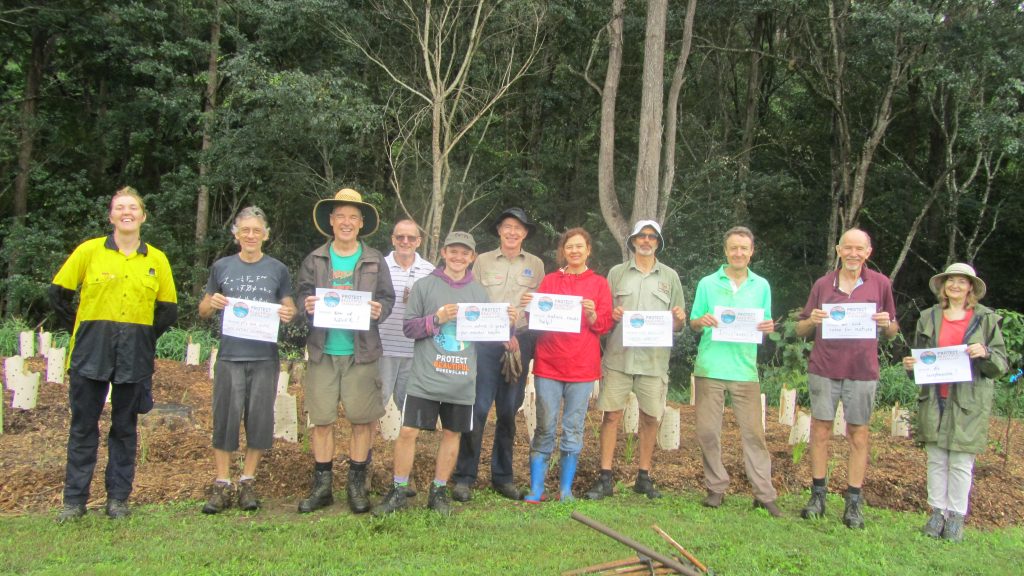 Moggill Creek Catchment Group (MCCG) is always seeking new volunteers for our working bees and other activities. Working bees provide an ideal opportunity to commune with nature, keep fit and meet some interesting neighbours, so if you can spare about 3 hours/month, please contact me ([email protected]).
Jim Pope
One of the aims of the MCCG is to restore the catchment to pre-colonisation as much as possible.
This aim is to support the return of the flora and fauna to something like what it was before our forebears cleared the land to supply food and timber to the emerging Brisbane settlement.
To achieve this the MCCG has strongly encouraged the planting of plants native to the local area and the removal of exotic weed species.
Unfortunately, much of the catchment has been developed as pasture for horses with extensive planting of trees. The habitat this produces only encourages aggressive species such as Magpies, Butcherbirds and Mickeys.
When you consider what was here before was a huge variety of different habitats including large areas of vine forest and dry rainforest, the task of supporting the fauna that was here before settlement is never going to be achieved.
The recent seasons have been interesting in that despite excellent growing conditions the range of bird species present has been severely reduced and is only just starting to recover after several good years. It is quite apparent that we are not breeding enough birds in the catchment and are dependent on birds coming in from areas outside the catchment to replace those lost in the previous drought.
That we can support a wide range of species (over 170 species on my property) has been that they are largely supported by exotics, including several weed species such as Lantana, Chinese Elm, Camphor Laurel and Brazilian Cherry. These “weeds” are highly prolific when compare with natives. For instance, Lantana not only produces flowers and berries most of the year, the fruit dries out and hangs on the bushes through winter like dried out sultanas, which support a range of fruit eaters when nothing else is available. At the same time Lantana provides an impenetrable habitat for a range of animals such as Pademelons, Bettongs, Echidnas and nesting sites for finches and fairy wrens.
While I am not suggesting we plant Lantana, we need to look at the plusses of exotic weeds and balance this information against the negatives. Clearing Lantana without considering what it is supporting is poor conservation.
What we can do is replace the weeds with productive species. The hybrid varieties of Grevilleas and Callistemons (now Melaleucas) flower far more frequently than the native species and support a range of birds.
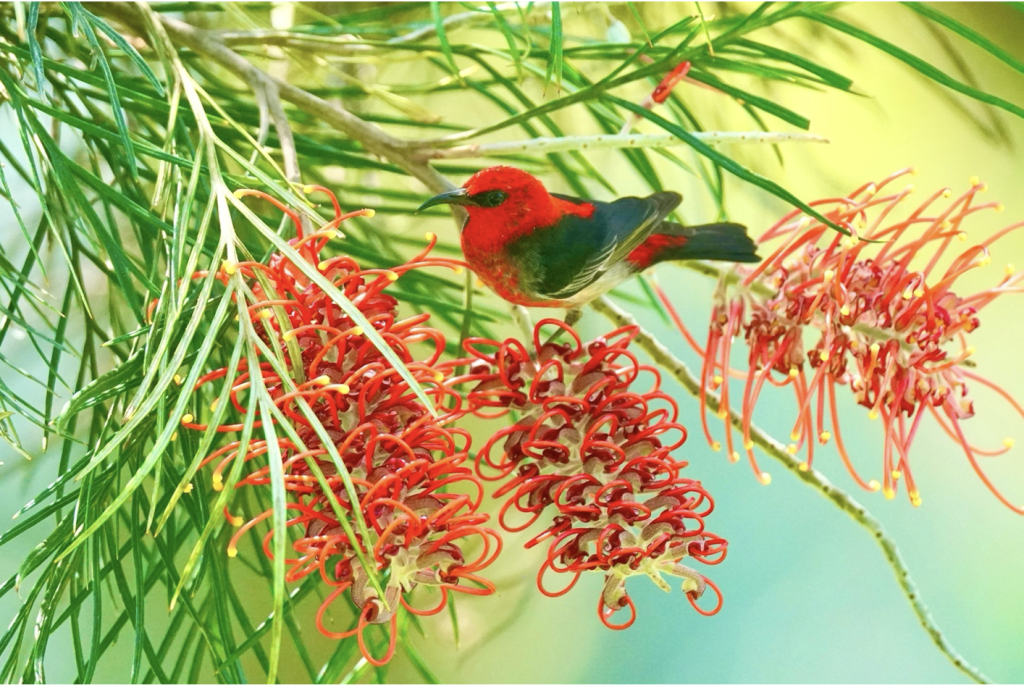 A Scarlet Honeyeater taking nectar from a highly productive hybrid Grevillea. Photo:Ed Frazer
Some “weeds” determined by the BCC are not excessively weedy in the catchment and should not be removed. For instance, the Brazilian Cherry grows more like a shrub in our soils and doesn’t spread widely like it does in Florida. It produces a huge load of berries in the heart of winter, supporting Mistletoes birds and many other species when nothing else is available. Its shrubby nature also provides excellent habitat. The Camphor Laurel is a beautiful tree and it can be easily contained so it doesn’t spread. It is hugely productive and research has shown it attracts and supports many native birds that bring in seeds of native species that are beneficial to support fruit eaters. Removing mature Camphor Laurels often results in a huge germination of seedlings that become a greater problem to control.
When developing a property in the Catchment give some thought to what is existing in the area before removing the exotics that may be supporting the wildlife. Select high producing natives, such as hybrid Callistemon and Grevilleas and consider exotics such as Guavas and Citrus. Plant new habitat before clearing weeds such as Lantana. If you clear the Lantana habitat first the wildlife its supporting will go away and probably never return. Consider species that support insects and provide fruit. Add a water feature with heavy planting to give safe access and you will go a long way to helping the Catchment supporting the wildlife that was here before settlement.
Ed Frazer
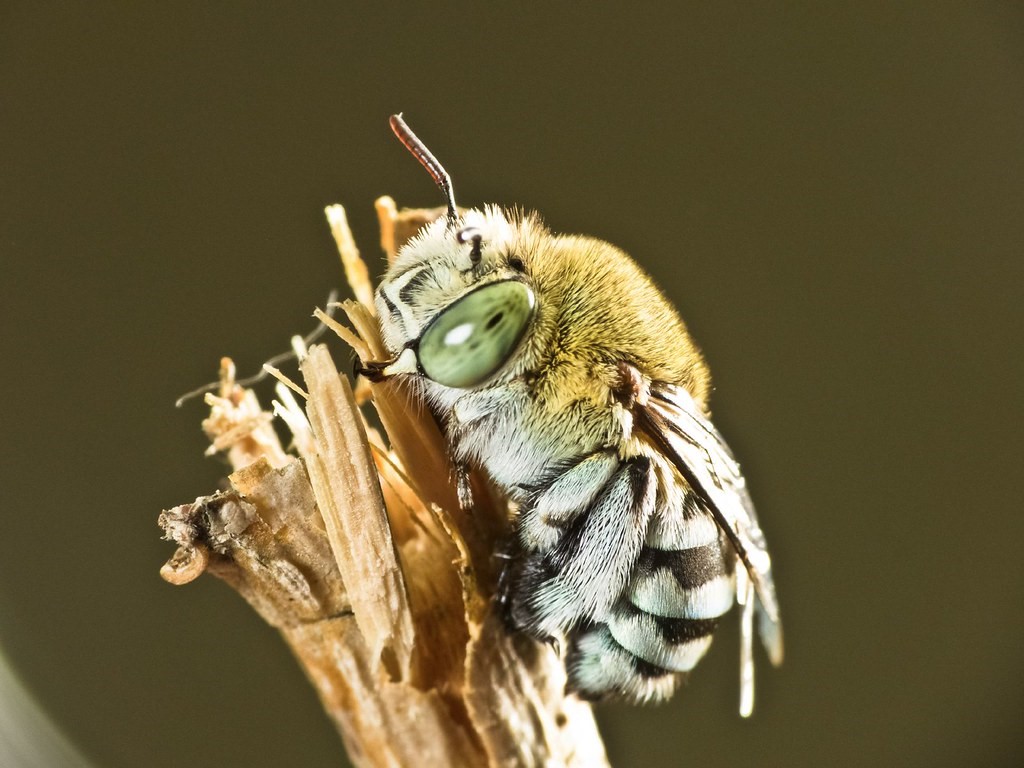
Blue-banded bees (Amegilla spp.) are a group of solitary bees found in the Moggill Creek catchment. They are known for their distinctive blue-black and yellow striped body, and are commonly found in gardens, parks, and other urban areas. They have become somewhat famous in Australia, as they are attractive insects, and lend themselves to photography well. They are also relatively unaggressive, and reluctant to sting unless captured. At least three species are present in the catchment, but they require detailed, often microscopic examination to confirm their ID.
These insects are small but squat, with a body length of around 10-15 mm. They have a distinctive orange-brown body and legs, with a striking black and bright blue banding on the abdomen. They have a long tongue, which they use to collect nectar and pollen from flowers. Active during the day, they have a distinctive “dart and hover” flight pattern, quite different from the gentle up-and-down meandering flight of European honeybees.
Unlike honeybees and stingless social bees, blue-banded bees are solitary, which means they do not live in colonies or hives. Instead, each female builds her own nest in small cavities, such as in the ground or in hollow stems or twigs. They are known to reuse abandoned nests, such as those of other bees or wasps. They usually lay their eggs in small cells, provisioning each cell with a mixture of nectar and pollen, on which the larvae feed. The female will then seal the cell and the larvae will develop and pupate inside, before emerging as adults.
Blue-banded bees are important pollinators for a variety of plants, including tomatoes, cucumbers, zucchinis, sunflowers, and many native species. They have been found to be more effective pollinators than honeybees, for certain plants. Their long tongues allow them to reach deep into the flowers to collect nectar and pollen, which makes them more effective at pollinating plants with a deep corolla. Blue-banded bees effect a special kind of pollination, known as “buzz-pollination” that efficiently moves pollen across some plant species, such as the tomato (Solanaceae) family. They do this by grasping a flower and shivering their flight muscles.
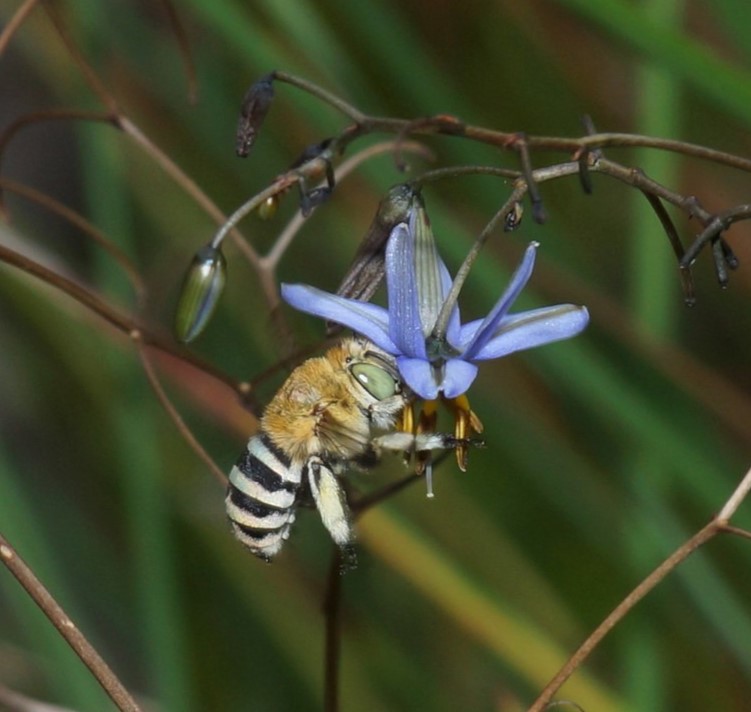
Populations of blue-banded bees in Queensland appear numerous, and there are no current conservation concerns regarding them. However, like many pollinator insects, they may be affected by habitat loss and degradation and by pesticide use. It is important to protect and conserve their habitats and reduce the use of pesticides in order to ensure the survival of these important pollinators. One way to help maintain blue-banded bees is to plant appropriate food plants, such as native Myrtaceae such Melaleuca spp, Dianella spp., Hibbertia spp. and native, blue-flowered plants. However, at least some local species seem strongly attracted to non-native plants such as Lavenders and Duranta. One can also provide “bee hotels”with small, rounded holes or gaps in outdoor objects, which these insects use for their solitary nests.
Sandy Pollock
Blue-banded Bee (Amegilla spp.) – photo Robert Whyte
Blue-banded Bee and favourite flower – photo ‘Ron_n_Beths pics’
Wildlife Matters is published in:
